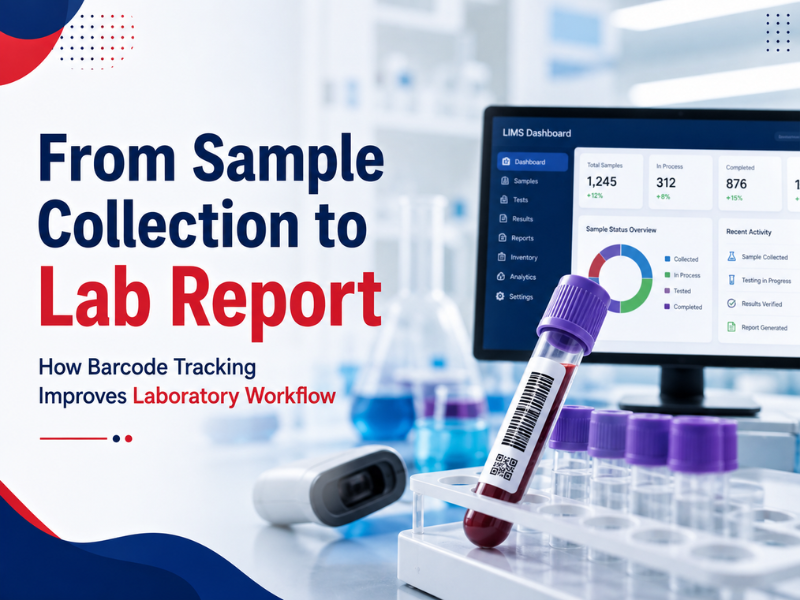
From Sample Collection to Lab Report: How Barcode Tracking Improves Laboratory Workflow
Laboratories handle hundreds or even thousands of patient samples every day. From blood and urine samples to other diagnostic specimens, every sample must be correctly identified, processed, tested and linked to the right patient.
Even a small error in sample identification can create serious problems, including delayed testing, incorrect records, repeated sample collection and delays in report delivery.
This is why barcode tracking in laboratory management has become an important part of modern laboratory workflows.
When barcode technology is combined with LIMS software, laboratories can create a connected process from patient registration and sample collection to testing, report generation and digital report dispatch.
An integrated workflow can help laboratories improve traceability, reduce manual data entry and provide better visibility into sample status.
What Is Barcode Tracking in Laboratory Management?
Barcode tracking is a digital method of identifying and monitoring laboratory samples throughout their journey.
A unique barcode can be associated with a patient's laboratory order and sample. The barcode can then be scanned at different stages of the workflow.
A typical process can look like:
Patient Registration → Test Booking → Sample Collection → Barcode Generation → Sample Processing → Testing → Result Entry → Report Verification → Report Generation → Report Dispatch
Instead of relying only on handwritten labels or manually entered sample numbers, barcode tracking provides a digital identification method that can be used throughout the laboratory workflow.
Why Sample Tracking Is Important for Modern Laboratories
A laboratory sample passes through multiple stages and may be handled by different staff members.
Without an organized tracking system, laboratories may face challenges such as:
- Sample identification errors
- Manual data-entry mistakes
- Difficulty locating samples
- Delays in processing
- Duplicate information
- Report generation delays
- Difficulty tracking sample status
A barcode-enabled Laboratory Information Management System (LIMS) can connect these stages and provide a more structured workflow.
1. Patient Registration Starts the Laboratory Journey
The laboratory workflow often begins when a patient is registered at the hospital, clinic or diagnostic center.
Patient information may include:
- Patient name
- Contact details
- Patient ID
- Doctor information
- Test requirements
- Visit information
With an integrated healthcare platform, patient information can flow from the broader HIMS or clinic management system into the laboratory workflow.
This reduces the need to repeatedly enter the same patient information.
For example:
OPD Consultation → Test Request → Laboratory Order → Sample Collection
This creates a connected journey between clinical and laboratory operations.
2. Test Booking and Sample Collection
Once a laboratory test is requested, the required sample needs to be collected.
Depending on the test, the laboratory may collect different types of specimens.
At this stage, accurate identification is critical.
A barcode can be generated for the sample and linked with the patient's laboratory order.
The barcode may contain or represent a unique sample identification number, allowing laboratory staff to identify the sample digitally during subsequent stages.
3. Barcode Generation Creates a Unique Sample Identity
The barcode becomes the digital identity of the sample.
Instead of depending entirely on handwritten information, laboratory staff can scan the barcode to retrieve the associated sample or order information.
This can help connect:
Patient → Test Order → Sample → Test → Result → Report
For laboratories handling a high volume of samples, this connection can be especially useful for maintaining sample traceability.
4. LIMS Connects the Laboratory Workflow
Barcode technology becomes even more valuable when integrated with LIMS software.
A Laboratory Information Management System can help manage different laboratory activities, including:
- Test orders
- Sample information
- Sample processing
- Result entry
- Report management
- Report verification
- Report dispatch
- Laboratory dashboards
With barcode tracking, the LIMS can associate the sample with the correct laboratory workflow.
This reduces dependence on manually searching for sample information at every stage.
5. Sample Processing and Tracking
After collection, samples may need to move through different laboratory processes.
The sample status can progress through stages such as:
Collected → Received → Processing → Testing → Result Ready → Verified → Reported
Barcode scanning at relevant stages can help laboratory staff identify the sample and update its status.
This provides greater visibility into where a sample is within the laboratory workflow.
For laboratory managers, this can make it easier to identify pending or delayed processes.
6. Analyzer Integration Improves Testing Workflow
Modern laboratories may use automated analyzers for different diagnostic tests.
Manually transferring information between laboratory systems and analyzers can create additional work and increase the possibility of data-entry errors.
Analyzer integration with LIMS can help connect laboratory orders, samples, test processing and results.
A connected workflow can look like:
LIMS → Sample → Analyzer → Test Result → LIMS → Lab Report
When barcode identification is included, the sample can be associated with the appropriate test and patient record throughout the process.
This creates a more connected laboratory workflow.
7. Result Entry and Verification
Once testing is completed, laboratory results need to be recorded and reviewed.
The LIMS can help organize:
- Test results
- Reference information
- Sample details
- Patient information
- Verification status
Laboratory professionals can review the results before the final report is released.
Barcode tracking helps maintain the connection between the sample, patient and corresponding laboratory report.
8. Lab Report Generation
The final output of the laboratory workflow is the diagnostic report.
A well-connected LIMS can help generate reports using information already associated with the laboratory order.
The workflow becomes:
Patient Registration → Sample Collection → Barcode → Testing → Result → Verification → Lab Report
This can reduce the need to repeatedly enter patient and test information while preparing reports.
It also helps maintain consistency between the original test request and the final report.
9. Digital Report Dispatch Improves Accessibility
Once a report is verified, it needs to reach the appropriate patient, doctor or healthcare provider.
Digital report dispatch management can help laboratories distribute reports through available digital channels.
This can reduce dependence on manual printing and physical collection.
For patients, faster digital access can make it more convenient to receive their laboratory results.
For healthcare providers, quicker report availability can support timely clinical decision-making.
Lab Management Software
10. Live Lab Dashboards Improve Workflow Visibility
Laboratory managers need visibility into daily operations.
A Live Lab Dashboard can provide information about activities such as:
- Total samples
- Pending samples
- Tests in progress
- Completed tests
- Reports awaiting verification
- Reports dispatched
When barcode tracking is connected with the LIMS, sample activity can be reflected throughout the laboratory workflow.
This gives laboratory teams better visibility into operational status.
11. Connecting Laboratory Management with Pharmacy and Inventory
Laboratory operations do not work independently from the rest of a healthcare organization.
A hospital or diagnostic center may also need to manage:
- Pharmacy
- Medical supplies
- Consumables
- Inventory
- Billing
- Patient services
For example, laboratory consumables and other supplies need to be available for testing activities.
An integrated Inventory Management system can help organizations monitor stock and supplies alongside other healthcare operations.
Similarly, Pharmacy Management can remain connected to the wider patient-care ecosystem.
This creates a broader workflow rather than treating the laboratory as an isolated department.
12. Connecting LIMS with Billing and HIMS
Laboratory services are often part of a larger hospital or clinic workflow.
A patient's journey may look like:
Registration → OPD Consultation → Test Request → Billing → Sample Collection → Laboratory → Report → Doctor Review
When HIMS, billing and LIMS work within a connected healthcare ecosystem, relevant information can move between these processes.
This can reduce repetitive administrative work and help maintain consistency across patient, laboratory and billing records.
How Barcode Tracking Improves Laboratory Workflow
Barcode-enabled LIMS can provide several operational benefits.
Better Sample Identification
Unique barcode identification helps laboratory staff associate samples with the appropriate patient and test order.
Improved Sample Traceability
Staff can track samples through different stages of the laboratory workflow.
Reduced Manual Data Entry
Scanning can reduce the need to repeatedly enter sample identification information.
Better Workflow Visibility
Laboratory teams can monitor sample progress and pending activities.
Faster Report Processing
Connected sample and result information can support more efficient report generation.
Improved Patient Service
Digital report dispatch can help patients and doctors receive reports more conveniently.
The Complete Barcode-Enabled Laboratory Workflow
An integrated laboratory workflow can be represented as:
Patient Registration
↓
OPD / Clinic / Hospital Consultation
↓
Test Request
↓
Billing
↓
Sample Collection
↓
Barcode Generation
↓
Sample Tracking
↓
Analyzer / Laboratory Testing
↓
Result Entry
↓
Report Verification
↓
Lab Report Generation
↓
Digital Report Dispatch
↓
Doctor Review / Patient Follow-Up
This connected approach demonstrates how barcode tracking can become part of the complete healthcare journey rather than being used only for sample labeling.
How DotHealth Supports Connected Laboratory Management
DotHealth brings laboratory operations together with broader healthcare-management processes.
Its healthcare ecosystem can connect:
- HIMS
- OPD Management
- IPD Management
- Clinic Management
- LIMS
- Barcode-Based Sample Tracking
- Analyzer Integration
- Live Lab Dashboards
- Report Dispatch Management
- Pharmacy Management
- Inventory Management
- Billing & Invoicing
- Physiotherapy Management
- Reports & Analytics
This integrated approach allows healthcare organizations to connect patient information with laboratory and hospital workflows.
For example:
OPD → Test Request → LIMS → Barcode → Analyzer → Result → Lab Report → Report Dispatch
At the same time, related services such as billing, pharmacy and inventory can remain part of the wider healthcare-management environment.
Frequently Asked Questions
What is barcode tracking in a laboratory?
Barcode tracking is a method of assigning a unique barcode to a laboratory sample so it can be identified and tracked through different stages of testing and reporting.
How does barcode technology help laboratories?
Barcode technology can improve sample identification, traceability and workflow management while reducing repetitive manual data entry.
Can barcode tracking be integrated with LIMS?
Yes. Barcode tracking can be integrated with LIMS to connect sample identification with test orders, processing, results and reports.
How does LIMS improve laboratory workflow?
LIMS can help laboratories manage test orders, samples, results, reports, verification and dispatch through a centralized digital workflow.
What is analyzer integration in LIMS?
Analyzer integration connects laboratory instruments with the LIMS so relevant testing information and results can move between the analyzer and laboratory system.
Can LIMS connect with hospital management software?
An integrated healthcare platform can connect laboratory workflows with HIMS, OPD, IPD, billing and other healthcare operations, depending on the system's integration capabilities.
Conclusion
Laboratory management involves much more than testing a sample. Every sample must be correctly identified, tracked, processed, tested, verified and linked to the appropriate laboratory report.
Barcode tracking combined with LIMS software can help laboratories create a more connected workflow from sample collection to report dispatch.
By connecting patient registration, OPD, billing, sample collection, barcode tracking, analyzer integration, result processing, report verification, digital report dispatch and laboratory dashboards, healthcare organizations can create better visibility across the diagnostic workflow.
With DotHealth, laboratories can also connect LIMS with broader HIMS, IPD, pharmacy, inventory, billing and other healthcare-management modules, creating an integrated digital ecosystem for hospitals, clinics and diagnostic centers.
Connect Every Step of Your Laboratory Workflow with DotHealth
From sample collection to verified lab reports, manage your laboratory operations with an integrated LIMS and healthcare management platform.