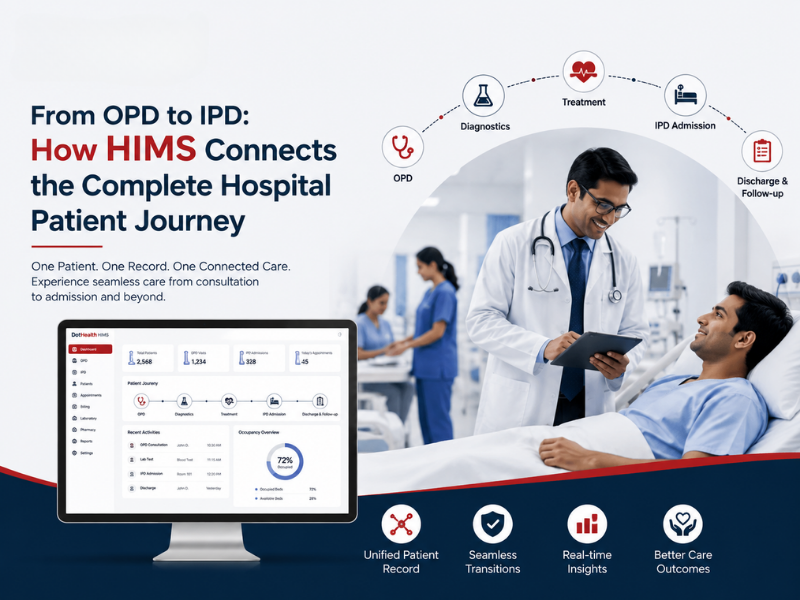
From OPD to IPD: How HIMS Connects the Complete Hospital Patient Journey
A patient's journey through a hospital can involve multiple departments, healthcare professionals, and administrative processes.
It may begin with OPD registration, followed by a doctor consultation, diagnostic investigation, prescription, billing, pharmacy, or even admission to the hospital for further treatment.
When these processes are managed through separate systems or manual records, hospitals may face challenges such as duplicated data, disconnected patient information, delays, and additional administrative work.
This is where a Hospital Information Management System (HIMS) can make a significant difference.
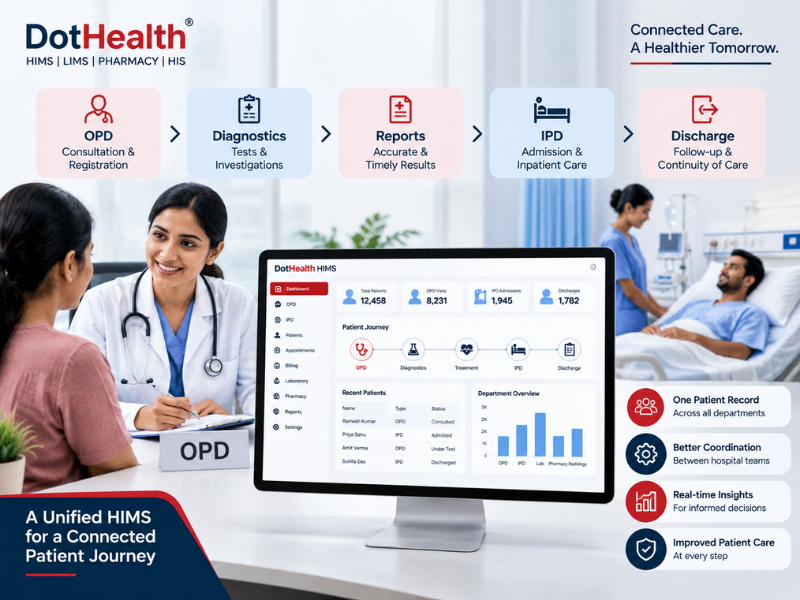
An integrated HIMS connects important hospital workflows, allowing patient information and operational processes to move more efficiently from OPD to IPD and eventually to discharge and follow-up.
What Is the Difference Between OPD and IPD?
Before understanding the role of HIMS, it is important to understand the difference between the two.
OPD – Outpatient Department
OPD generally manages patients who visit the hospital for consultation or treatment without being admitted.
The OPD journey may include:
- Patient registration
- Appointment scheduling
- Doctor consultation
- Diagnosis
- Prescription
- Laboratory tests
- Pharmacy
- Billing
- Follow-up appointments
IPD manages patients who require hospital admission and stay for treatment or observation.
The IPD workflow may include:
- Admission
- Bed allocation
- Doctor visits
- Nursing and clinical records
- Diagnostic investigations
- Medication
- Pharmacy
- Billing
- Discharge
- Follow-up
While OPD and IPD have different workflows, they often involve the same patient.
That is why connecting both processes is important for modern hospitals.
Why OPD and IPD Integration Matters
Consider a patient who initially visits the OPD with a health concern.
After consultation and investigation, the doctor may decide that the patient needs hospitalization.
If OPD and IPD systems are disconnected, hospital staff may need to enter the patient's information again during admission.
This can result in:
- Duplicate data entry
- Delays during admission
- Inconsistent patient information
- Difficulty accessing previous records
- Additional administrative work
With an integrated HIMS, information collected during the OPD journey can become part of the patient's broader hospital record, subject to appropriate access controls.
This creates a more connected patient journey.
The Complete OPD to IPD Patient Journey
A modern hospital workflow can look like:
Patient Registration
↓
Appointment / OPD
↓
Doctor Consultation
↓
Diagnosis & Investigation
↓
Prescription / Treatment Plan
↓
IPD Admission if Required
↓
Bed Allocation
↓
Inpatient Treatment
↓
Pharmacy & Inventory
↓
Billing
↓
Discharge
↓
Follow-Up
An integrated HIMS helps connect these stages within one healthcare environment.
Patient Registration Creates the Starting Point
The patient journey begins with registration.
Important information may include:
- Patient details
- Contact information
- Medical information
- Previous visit details
- Identification information
- Appointment information
A centralized Patient Management system helps hospitals maintain this information digitally.
Instead of creating a completely new record for every visit, the hospital can maintain a continuous patient history where appropriate.
DotHealth's patient-management capabilities help create a centralized digital environment for managing patient information across different healthcare workflows.
Appointment and OPD Management Organize Outpatient Visits
After registration, patients may book an appointment with the appropriate doctor or department.
The OPD workflow can include:
Appointment → Registration → Queue → Consultation → Prescription → Investigation → Billing
An OPD Management Software system helps organize these activities digitally.
This can help hospitals manage patient flow while reducing dependence on manual registers and disconnected processes.
DotHealth's HIMS supports OPD workflows as part of its broader hospital-management ecosystem.
Doctor Consultation Adds Important Clinical Information
During consultation, doctors may record information such as:
- Patient complaints
- Medical history
- Diagnosis
- Clinical observations
- Prescription
- Treatment recommendations
- Follow-up requirements
These records become important if the patient later requires admission.
When the hospital uses an integrated HIMS, relevant patient information can be available as part of the patient's broader record, based on user permissions and hospital processes.
Laboratory and Diagnostic Services Support Clinical Decisions
A doctor may recommend laboratory or diagnostic investigations during an OPD visit.
The workflow can become:
OPD Consultation → Test Request → Laboratory → Report → Doctor Review
This is where integration between HIMS and LIMS becomes valuable.
DotHealth includes LIMS capabilities, helping connect laboratory workflows with the broader healthcare ecosystem.
When a patient later moves from OPD to IPD, relevant diagnostic information can contribute to the continuity of the patient's hospital record.
When OPD Patients Need IPD Admission
Not every patient requires hospitalization.
However, when a doctor determines that inpatient treatment is required, the patient can move from the outpatient workflow to the inpatient workflow.
This transition is one of the most important stages of the hospital patient journey.
Instead of starting from scratch, an integrated HIMS can help hospitals carry relevant patient information into the admission process.
This can reduce duplicate data entry and help staff work with a more complete patient record.
IPD Admission and Bed Management
Once the patient is admitted, the hospital needs to manage:
- Admission details
- Ward
- Bed allocation
- Doctor assignment
- Patient status
- Treatment information
- Billing information
IPD Management Software helps hospitals organize these processes.
Bed management is particularly important for hospitals with multiple wards and high patient volumes.
A centralized HIMS can provide better visibility into inpatient operations and available resources.
Inpatient Treatment Requires Connected Information
During an IPD stay, the patient's healthcare journey becomes more complex.
Different departments may become involved, including:
- Doctors
- Nurses
- Laboratory
- Pharmacy
- Billing
- Inventory
- Physiotherapy
When these departments operate through disconnected systems, information may need to be transferred manually.
An integrated HIMS creates a more connected environment where relevant information can move between workflows.
Pharmacy Becomes Part of the Patient Journey
Medication is an important part of both OPD and IPD treatment.
The workflow may include:
Doctor Prescription → Pharmacy → Medicine Issue → Inventory Update → Billing
When pharmacy operations are connected with hospital workflows, staff can manage medication-related information more efficiently.
DotHealth includes Pharmacy Management, allowing pharmacy operations to form part of the broader healthcare-management ecosystem.
Inventory Management Supports Hospital Operations
Pharmacy and clinical operations depend on the availability of medicines and supplies.
Hospitals need to monitor:
- Medicine stock
- Medical supplies
- Stock movement
- Expiry
- Reorder requirements
- Consumption
An integrated Inventory Management system helps hospitals maintain better visibility into stock.
DotHealth's inventory capabilities can connect inventory operations with pharmacy and other hospital workflows.
This demonstrates why hospital management should not be limited to patient records alone.
Billing Connects OPD and IPD Financial Workflows
Billing is another major component of the patient journey.
In OPD, billing may include:
- Consultation fees
- Diagnostic services
- Procedures
- Pharmacy purchases
In IPD, billing can become more extensive and may include:
- Room or bed charges
- Doctor charges
- Procedures
- Investigations
- Medicines
- Other hospital services
An integrated billing system can help bring relevant transactions together.
DotHealth supports Billing & Invoicing, helping healthcare organizations manage financial workflows alongside patient and hospital operations.
Physiotherapy Can Become Part of the Patient Journey
Some patients may require physiotherapy during or after treatment.
For example:
Diagnosis → IPD Treatment → Physiotherapy → Discharge → Follow-Up
Physiotherapy information can become part of the patient's broader healthcare journey.
DotHealth includes Physiotherapy Management, allowing healthcare organizations to manage physiotherapy operations as part of the larger digital healthcare ecosystem.
Discharge Completes the IPD Journey
Discharge is not simply the final administrative step.
It may involve:
- Final billing
- Discharge summary
- Medication instructions
- Follow-up recommendations
- Investigation reports
- Treatment information
- Future appointment requirements
An integrated HIMS can help bring relevant information together for the discharge process.
This creates a smoother transition from IPD treatment to post-discharge follow-up.
Follow-Up Continues the Patient Journey
The patient journey does not necessarily end at discharge.
Patients may return for:
- Follow-up consultations
- Diagnostic reviews
- Medication reviews
- Physiotherapy
- Further treatment
- Routine check-ups
A centralized patient record helps healthcare teams understand the patient's previous interactions with the hospital.
This creates a continuous journey:
OPD → IPD → Discharge → Follow-Up → OPD
How HIMS Connects Different Hospital Departments
One of the biggest advantages of an integrated Hospital Management System is that it connects departments rather than managing them independently.
A typical DotHealth ecosystem can connect:
|
Hospital Function |
Role in Patient Journey |
|
Patient Management |
Central patient information |
|
OPD |
Outpatient consultation |
|
IPD |
Inpatient treatment |
|
LIMS |
Laboratory investigations |
|
Pharmacy |
Medication management |
|
Inventory |
Medicine and supply management |
|
Billing |
Financial transactions |
|
Physiotherapy |
Rehabilitation and therapy |
|
Reports |
Operational insights |
This interconnected approach helps hospitals manage the patient journey more effectively.
Benefits of Integrated OPD and IPD Management
Better Patient Information Management
Relevant information can be maintained within a centralized digital environment.
Reduced Duplicate Data Entry
Staff can avoid repeatedly entering the same information across disconnected systems.
Improved Department Coordination
Different hospital departments can work with connected workflows.
Better Billing Management
OPD and IPD transactions can be managed through integrated billing processes.
Improved Pharmacy Coordination
Prescription, medicine, and inventory workflows can be connected.
Better Reporting
Management can access operational information across departments.
Improved Patient Experience
A more connected workflow can reduce unnecessary administrative delays.
Why Hospitals Should Move Beyond Standalone Systems
A hospital is made up of interconnected departments.
Managing OPD through one system, IPD through another, pharmacy through spreadsheets, and billing through a separate application can create information gaps.
An integrated HIMS provides a broader solution.
Instead of:
OPD System + IPD System + Pharmacy System + Billing System + Inventory System
hospitals can work toward:
One Connected Healthcare Management Ecosystem
This is particularly valuable for hospitals that are expanding their services or operating across multiple locations.
How DotHealth Supports the Complete Hospital Journey
DotHealth is designed as an integrated healthcare software ecosystem covering multiple healthcare operations.
Its modules include:
- HIMS
- OPD Management
- IPD Management
- Clinic Management
- Patient Management
- LIMS
- Pharmacy Management
- Inventory Management
- Physiotherapy Management
- Billing & Invoicing
- Reports & Analytics
- Multi-Location Management
This allows healthcare organizations to connect different stages of the patient and hospital-management journey.
From OPD registration to IPD admission, pharmacy, diagnostics, billing, discharge, and follow-up, DotHealth provides a connected digital environment for managing healthcare operations.
Frequently Asked Questions
What is OPD to IPD integration?
OPD to IPD integration connects outpatient and inpatient workflows so relevant patient information and hospital processes can move more efficiently when an OPD patient requires admission.
What is HIMS software?
HIMS, or Hospital Information Management System, is software that helps hospitals manage patient information and operational workflows such as OPD, IPD, billing, pharmacy, laboratory, inventory, and reporting.
Why should OPD and IPD be connected?
Connecting OPD and IPD can reduce duplicate data entry, improve access to patient information, and create a more continuous patient journey.
Can HIMS connect pharmacy and laboratory operations?
An integrated HIMS ecosystem can connect hospital workflows with pharmacy and laboratory systems, depending on the platform's capabilities and configuration.
How does DotHealth connect OPD and IPD?
DotHealth provides OPD and IPD management as part of its broader HIMS ecosystem, along with patient management, billing, pharmacy, inventory, LIMS, physiotherapy, and reporting capabilities.
Conclusion
The modern hospital patient journey does not happen in a single department. A patient may move from OPD consultation to diagnostic investigation, IPD admission, pharmacy, billing, discharge, and follow-up.
When these processes operate independently, hospitals may face data duplication, communication gaps, and administrative delays.
An integrated HIMS connects these workflows and helps healthcare organizations manage the patient journey through a centralized digital environment.
With DotHealth, hospitals can connect OPD, IPD, Patient Management, LIMS, Pharmacy, Inventory, Billing, Physiotherapy, and Reports within one healthcare ecosystem.
Connect OPD to IPD with DotHealth
Manage the complete hospital patient journey with integrated HIMS, OPD, IPD, pharmacy, laboratory, inventory, billing, and reporting solutions.