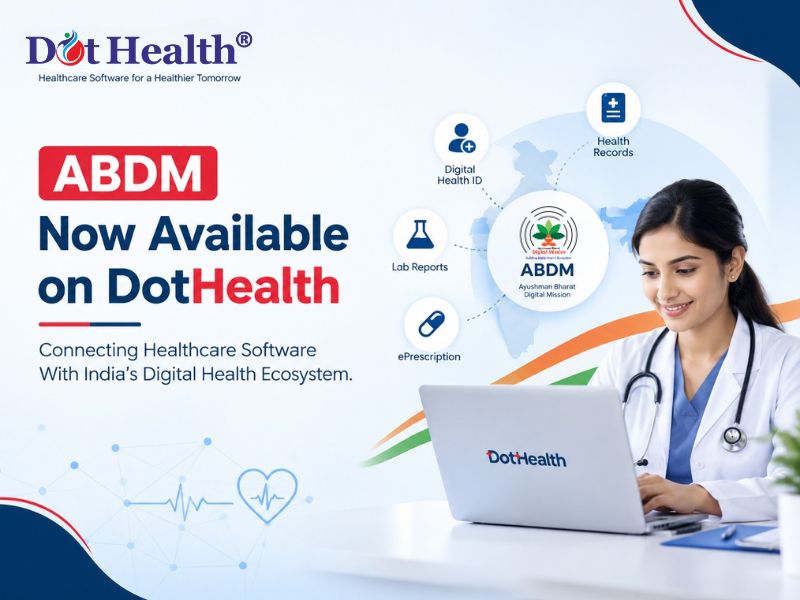
ABDM Now Available on DotHealth: Connecting Healthcare Software With India’s Digital Health Ecosystem
Healthcare in India is becoming increasingly digital. Hospitals, clinics, diagnostic laboratories and pharmacies are adopting healthcare software to manage patient records, appointments, laboratory workflows, billing, inventory and other daily operations.
At the same time, the Ayushman Bharat Digital Mission (ABDM) is building a connected digital health ecosystem designed to support interoperability between different healthcare stakeholders and digital health systems. ABDM includes important components such as ABHA, the Health Facility Registry and the Healthcare Professionals Registry.
With ABDM now available on DotHealth, healthcare organizations can take another step toward connecting their existing digital healthcare workflows with India's broader digital health ecosystem.
But what does ABDM integration mean for healthcare software, and why does it matter for modern hospitals, clinics and diagnostic centers?
Let's understand.
What Is ABDM?
The Ayushman Bharat Digital Mission (ABDM) is a national digital health initiative designed to create a connected and interoperable digital healthcare ecosystem in India.
One of its important objectives is to enable health information to move securely between intended stakeholders through interoperable digital systems.
ABDM includes several important components, including:
- ABHA – Ayushman Bharat Health Account
- Health Facility Registry (HFR)
- Healthcare Professionals Registry (HPR)
- Digital health information exchange
- Interoperable digital health infrastructure
ABHA provides an identity within the national digital health ecosystem, while the registries help connect recognized healthcare facilities and professionals.
The government has also emphasized consent-based information exchange and privacy by design as important principles of ABDM.
Why ABDM Matters for Healthcare Software
Healthcare organizations already generate large amounts of digital information.
A hospital may manage:
When healthcare systems operate in isolation, exchanging information between different platforms can become challenging.
This is where ABDM enabled healthcare software becomes relevant.
ABDM is designed to support interoperability, allowing different digital health systems to participate in a connected healthcare ecosystem rather than functioning entirely as separate systems.
DotHealth Is Now ABDM Enabled
With ABDM integration now available on DotHealth, healthcare organizations using the DotHealth ecosystem can move toward a more connected digital health workflow.
DotHealth already brings different healthcare operations together through solutions such as:
- HIMS
- LIMS
- Clinic Management
- Pharmacy Management
- Inventory Management
- Physiotherapy Management
- Healthcare portals and connected workflows
Adding ABDM enabled functionality creates an opportunity to connect these digital healthcare operations with India's wider digital health ecosystem.
This makes ABDM more than just a separate technology feature. It becomes part of the larger digital transformation journey of healthcare organizations.
The primary value of ABDM integration is interoperability.
Imagine a healthcare organization managing patients through different departments.
A patient may visit a clinic, undergo laboratory testing, receive a prescription and later return to the hospital for another consultation.
Each interaction can generate healthcare information.
With digital health infrastructure designed around interoperability, information can potentially be shared between participating systems through appropriate consent-based mechanisms rather than remaining locked within one isolated platform.
This supports the broader vision of a connected digital health ecosystem.
ABHA and Digital Health Records
One of the most important concepts associated with ABDM is ABHA, or Ayushman Bharat Health Account.
ABHA provides a digital identity within India's digital health ecosystem.
The ABDM framework is designed to enable individuals to link and manage digital health information through the ecosystem, with consent-based sharing of information. The official ABDM materials describe ABHA as a way to connect individuals with the national digital health ecosystem and support digital access to health records.
For healthcare providers, this creates an important shift:
Patient information → Digital Records → Connected Ecosystem → Consent-based Access
Healthcare software that can participate in the ABDM ecosystem can therefore become an important part of this digital health journey.
How ABDM Can Complement HIMS Software
HIMS software manages many operational and patient-related activities within hospitals.
These may include:
- Patient registration
- OPD management
- IPD management
- Billing
- Department workflows
- Patient records
- Hospital administration
With ABDM enabled HIMS software, the hospital's digital workflow can move toward greater interoperability with the national digital health ecosystem.
This can help healthcare organizations think beyond internal hospital automation and toward connected digital healthcare.
How ABDM Can Complement LIMS Software
Diagnostic laboratories generate important digital health information every day.
A LIMS software platform can manage:
- Sample registration
- Barcode tracking
- Laboratory workflows
- Analyzer integration
- Result entry
- Report generation
- Report dispatch
When healthcare software participates in the ABDM ecosystem, laboratory information can become part of a broader digital health environment where appropriate interoperability and consent mechanisms are available.
This is especially relevant as diagnostic information becomes an increasingly important part of a patient's digital health record.
ABDM and Clinic Management Software
Clinics also generate valuable digital information through consultations, appointments, patient records, prescriptions, billing and follow-ups.
Clinic management software can help organize these workflows digitally.
With ABDM-enabled healthcare software, clinics can move toward a more connected digital health environment instead of maintaining patient information only within isolated systems.
This supports the broader objective of creating interoperable digital health services across different healthcare providers.
ABDM and Patient-Centric Digital Healthcare
ABDM is not only about connecting software systems.
It is also about creating a more connected digital health ecosystem around individuals.
The official ABDM framework emphasizes citizen-centric digital healthcare, digital availability of information and secure, consent-based information exchange.
This can support a healthcare environment where digital health information is more connected across participating providers.
For healthcare organizations, adopting ABDM enabled software can therefore become part of a longer-term digital healthcare strategy.
Why Healthcare Organizations Should Consider ABDM-Enabled Software
As healthcare becomes increasingly digital, organizations need software that can support both their current operational requirements and the changing digital health ecosystem.
An ABDM enabled healthcare software solution can offer several strategic advantages:
1. Supports Interoperability
ABDM is built around common digital health standards and interoperable systems, helping different healthcare platforms participate in a connected ecosystem.
2. Supports Digital Health Transformation
Healthcare organizations can move beyond internal digitization toward participation in India's wider digital health infrastructure.
3. Connects Different Healthcare Workflows
HIMS, LIMS, clinic, pharmacy and other healthcare operations can continue to be managed digitally while the organization moves toward ABDM-enabled workflows.
4. Supports Patient-Centric Healthcare
ABHA and ABDM are designed to put individuals at the center of a connected digital health ecosystem.
5. Prepares Organizations for a Connected Future
ABDM adoption is expanding across India's healthcare ecosystem. As of February 2025, the government reported more than 73.98 crore ABHA accounts, around 49.06 crore health records linked with ABHA, and more than 1.59 lakh healthcare facilities using ABDM-enabled software.
These numbers demonstrate the growing scale of India's digital health infrastructure.
How DotHealth Supports the ABDM-Enabled Digital Journey
DotHealth is designed as a connected healthcare software ecosystem covering multiple areas of healthcare operations.
Its solutions include:
HIMS → LIMS → Clinic → Pharmacy → Inventory → Physiotherapy
With ABDM now available on DotHealth, the platform can support healthcare organizations looking to take their digital operations toward the next stage of healthcare interoperability.
Rather than adopting a completely separate system for every healthcare function, organizations can use connected DotHealth solutions while moving toward participation in the broader ABDM ecosystem.
This creates a stronger foundation for digital healthcare transformation.
ABDM Integration: More Than Just a Software Feature
It is easy to think of ABDM integration as simply another checkbox in healthcare software.
However, its importance is much broader.
The future of healthcare is increasingly moving toward connected digital ecosystems where hospitals, clinics, laboratories, healthcare professionals and patients can interact through interoperable digital infrastructure.
ABDM provides the national framework for this direction.
For healthcare software providers and healthcare organizations, becoming ABDM enabled is therefore part of preparing for a more connected digital healthcare environment.
Conclusion
India's healthcare ecosystem is moving toward greater digital connectivity, and the Ayushman Bharat Digital Mission is an important part of that transformation.
ABDM focuses on interoperability, digital health identities, healthcare registries and secure, consent-based information exchange.
With ABDM now available on DotHealth, healthcare organizations can move toward a more connected digital health journey while continuing to manage important operations through HIMS, LIMS, clinic, pharmacy, inventory and other DotHealth solutions.
The future of healthcare software is not simply about digitizing individual departments.
It is about connecting healthcare information, systems and people through a digital ecosystem.
And with ABDM-enabled capabilities, DotHealth is taking another step in that direction.
Frequently Asked Questions
What is ABDM?
ABDM stands for Ayushman Bharat Digital Mission, India's national initiative for building a connected and interoperable digital health ecosystem.
What is ABHA?
ABHA stands for Ayushman Bharat Health Account. It provides an identity within India's national digital health ecosystem and supports the linking and sharing of digital health records through appropriate consent mechanisms.
What is ABDM-enabled healthcare software?
ABDM-enabled healthcare software is digital health software that can participate in the ABDM ecosystem and support relevant interoperability and digital health workflows.
Why is ABDM integration important for hospitals?
ABDM integration can help hospitals move toward interoperable digital healthcare and participate in India's broader digital health ecosystem.
Is DotHealth now ABDM enabled?
Yes. ABDM is now available on DotHealth, adding an important capability to its connected healthcare software ecosystem.
Can ABDM work with HIMS and LIMS software?
ABDM's interoperability framework is designed to allow different digital health systems to participate in a connected ecosystem. HIMS and LIMS can therefore be part of an organization's broader ABDM-enabled digital health strategy, subject to the applicable integration and technical requirements.
Does ABDM mean all health records are stored in one central database?
No. ABDM documentation specifically describes a privacy-by-design approach and states that there is no centralized repository of health data; information exchange occurs between intended stakeholders after appropriate patient consent.